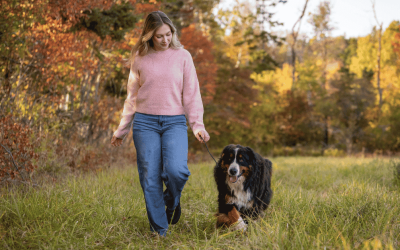

You grab the leash, head out the door, and expect to get some steps in. Your dog, however, has other plans. Three houses later, you’ve stopped to investigate a mailbox, a patch of grass, a fire hydrant, and one extremely important leaf. You’re left wondering, why does my dog stop so much on dog walks? If your dog stops frequently on walks, it doesn’t necessarily mean they’re stubborn, distracted, want to ruin your workout, or trying to make you late. Dogs experience walks very differently than we do. Sometimes stopping is part of what makes a walk so valuable. Here are some of the most common reasons dogs hit the brakes and why paying attention to those pauses can help you better understand your pup.
 1. They’re Sniffing, and That’s Important
Many dog parents tend to think of walks as physical exercise. For dogs, however, they’re also a major source of mental enrichment along with the physical benefits.
A dog’s senses give them an incredible amount of information about their environment, especially their sense of smell. That ordinary tree trunk can tell your dog which neighborhood dogs have passed by, what animals have been around, and what’s changed since yesterday.
Giving your dog appropriate opportunities to sniff allows them to explore and engage their brain.
That’s why at Shoreline Happy Paws, we don’t judge every walk by how many miles we cover. Sometimes a slower walk or hike turned sniffairi is exactly what a dog needs.
 2. They’re Taking In Their Environment
Not every stop is about a smell.
Your dog might pause because they heard construction in the distance, spotted another dog, noticed a person approaching, or encountered something unfamiliar.
Dogs are constantly processing information on walks. A pause can simply mean, “Hang on. I need to figure this out.” Is it the UPS truck, the garbage truck, or a loud vehicle? Was that a bunny? These are all very important mysteries to be solved while your dog engages with the world around them.
At Shoreline Happy Paws, instead of immediately pulling them forward, our dog walkers pay attention to dogs’ body language. Are they relaxed and curious? Or have they become stiff, hesitant, or worried? Those details matter because they tell us what to do next.
 3. Something Might Be Making Them Uncomfortable
If a dog suddenly refuses to continue in a particular direction, there’s often a reason.
Maybe there’s a barking dog behind a fence ahead. Perhaps a loud truck is making an unfamiliar or dangerous noise. A reactive or anxious dog may have noticed a trigger long before their human has.
This is one reason we believe professional dog walking involves much more than holding the other end of a leash. Rather, we read canine body language during walks, which helps us determine whether a dog needs reassurance, more distance from something, a different route, or simply a moment to process what’s happening.
 4. They May Need a Break
Sometimes stopping is your dog’s way of saying, “I need a minute”, “I’m tired.”, or “I hurt my paw.”
Age, health, fitness level, temperature, humidity, and terrain can all affect a dog’s stamina.
While still enjoying their walks, senior dogs may naturally need more breaks than young adults. Dogs with shorter snouts, thick coats, or certain health considerations may also tire and/or heat up more quickly.
If your dog suddenly starts stopping much more frequently than usual, seems reluctant to exercise, develops an unusual gait, or shows other changes, it’s worth discussing those observations with your veterinarian. If we notice these changes during your dog’s walk with us, we’ll be sure to bring our observations to your attention.
 5. They’ve Learned That Stopping Gets Results
Dogs are excellent at discovering patterns.
If stopping at a particular house usually earns them attention or treats from a neighbor, they’ll probably remember. If planting all four paws beside a favorite sniffing spot earns another five minutes of investigation, well…that works too.
That doesn’t mean your dog is being “bad.” They’re simply learning what happens when they make certain choices.
A consistent walking routine can help create clearer expectations while still giving dogs appropriate opportunities to explore. Carrying treats with us helps us keep walks moving if we’re asked to prioritize exercise, while we may indulge other dogs with more sniff time if we think it benefits them.
Why Does My Dog Stop So Much on Dog Walks?
Does your dog stop a lot on dog walks? Maybe they don’t think they stop enough!
In reality, there’s no rule saying a successful dog walk must be fast, perfectly straight, or cover a certain distance, while you may prefer it to get those steps in.
At Shoreline Happy Paws, we believe in meeting dogs where they are. That means paying attention to body language, allowing time for appropriate sniffing, considering weather and environmental conditions, and adjusting the walk to the individual dog.
Recurring dog walks also give our dog walkers the chance to learn what’s normal for each pup. We get to know their typical pace, favorite sniffing spots, usual behaviors, and the places where they tend to hesitate. That familiarity can help us recognize when a stop is simply your dog reading the neighborhood “pee-mail” and when something seems different.
So the next time your dog comes to a complete stop because one blade of grass apparently contains the story of the century, give them a moment.
For us, it’s a walk around the neighborhood. For your dog, it’s an entire world to explore.
Dog Walking Pros in the CT Shoreline
We are currently accepting new clients for our dog walking and dog hiking adventure services. For a limited time, you can earn free dog walks when you sign up for recurring weekly walks!
New Shoreline Happy Paws clients can create an account. We will be in touch to further discuss your needs and set you and your family up with the care you need. Existing clients, please book services by logging in to your client profile.
We serve the following areas of the Connecticut Shoreline:
- Old Saybrook
- Essex, Ivoryton & Centerbrook
- Deep River
- Chester
- Westbrook
- Clinton
- Old Lyme
- East Lyme
- Niantic
Certain Parts and Certain Service Hours in:
- Lyme and Madison
- Waterford, New London, Groton
- Uncasville, Gales Ferry, Mystic, Noank